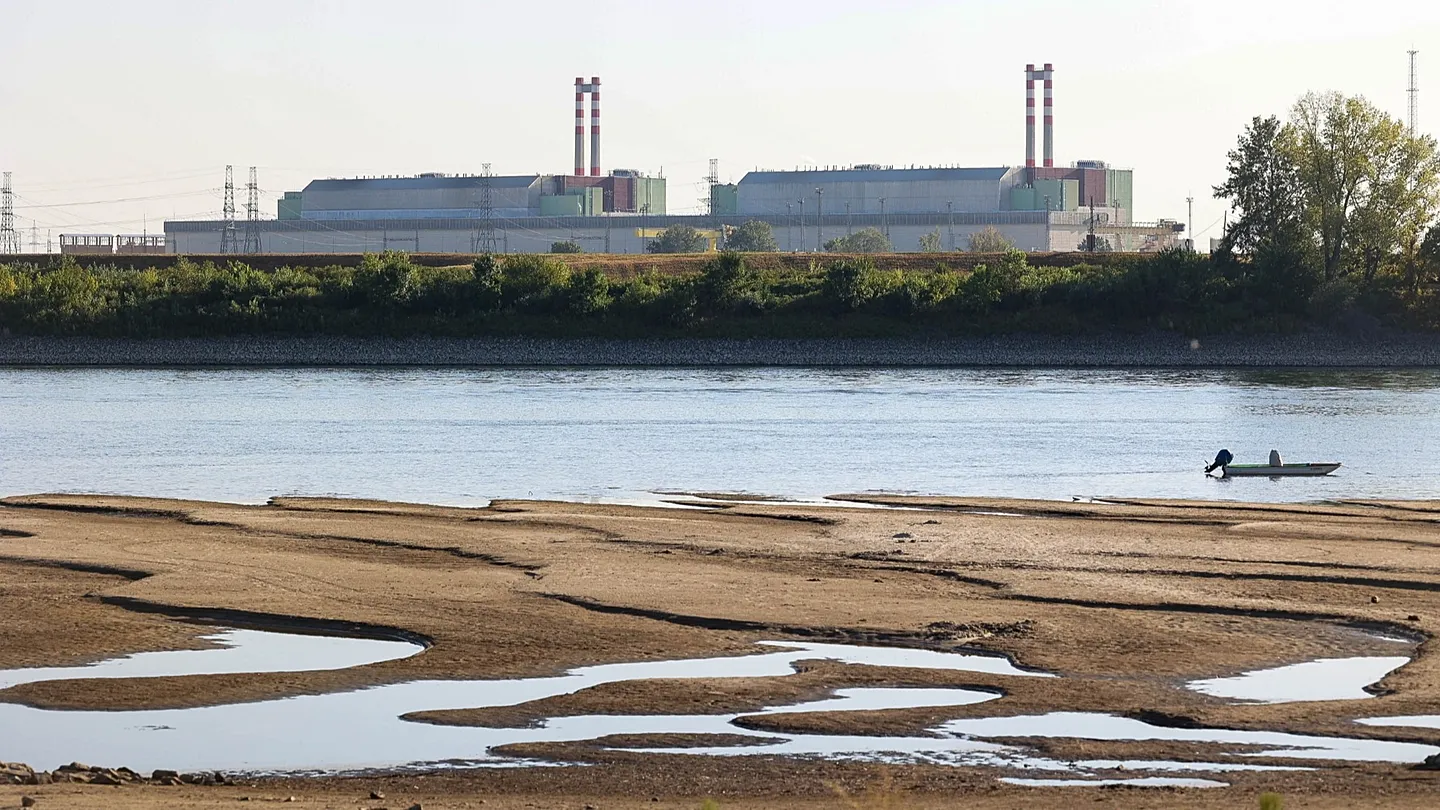
Record low Danube water levels have forced Hungary's only nuclear power plant offline for the first time in its history, creating cascading consequences for inland shipping, industrial supply chains and energy logistics across central Europe.
The Danube is not just a river. For the inland waterway shipping community, it is a working artery — a corridor carrying bulk commodities, containers, fuel, agricultural produce and industrial inputs across central and southeastern Europe. When water levels fall to record lows, every barge operator, freight charterer and port manager along its length feels the consequences. The shutdown of Hungary’s Paks nuclear power plant in early August 2026, forced by insufficient cooling water drawn from the Danube, marks a moment when the river’s deteriorating condition has escalated from an operational nuisance to a national emergency.
What Has Happened
Hungary’s Paks plant, which under normal conditions accounts for roughly 40% of the country’s electricity generation, has been shut down in its entirety for the first time in more than four decades of operation. Both remaining operational reactors were sequentially taken offline after progressive drought conditions reduced Danube water levels to the point where sufficient cooling water could no longer be reliably drawn. The plant, located roughly 120 kilometres south of Budapest, had already been operating at a fraction of its rated capacity before the final shutdown.
Romania, a neighbour sharing the wider Danube basin, moved simultaneously to reduce output at its own nuclear facility and declared an energy sector state of alert. Hungary’s government is now importing electricity to cover the shortfall, asking major industrial consumers — including automotive and battery manufacturers — to voluntarily reduce consumption, and warning that mandatory cuts may follow. Rail freight has been restricted during peak hours. Public transit has been slowed to save electricity. Decorative and non-essential lighting has been extinguished. Water for irrigation, including sports facilities, has been banned.
This is not a short-term weather event. It is the consequence of sustained drought across much of central Europe, compounding years of underinvestment in energy and water infrastructure resilience.
Why This Matters to Shipping
At first glance, a nuclear power plant going offline might seem remote from the concerns of shipowners, operators and chartering professionals. It is not. The connections are immediate and practical.
Danube Navigation Is Already Compromised
The same low water levels that deprived Paks of cooling water are the same low water levels that are throttling barge drafts along the river. Inland waterway operators on the Danube know this cycle well — drought years impose severe draft restrictions, reducing payloads, increasing the number of voyages required per cargo unit and raising freight rates for whatever capacity remains commercially viable. At extreme low water, certain reaches of the river become impassable for laden vessels, effectively closing sections of the route.
For bulk cargo operators — grain, coal, fertiliser, construction aggregates — the practical effect is that much of what would normally move by barge must divert to road or rail. Both modes are now under additional strain: rail freight has been curtailed at peak hours specifically to conserve electricity, and road haulage costs in central Europe have been rising independently. Shippers are caught between constrained river capacity and degraded land-based alternatives at precisely the same time.
Industrial Curtailment Hits Cargo Volumes
The government’s request — and potential mandatory order — for large industrial consumers to reduce output will directly suppress cargo demand. Hungary’s automotive and battery manufacturing sectors are significant generators of both import and export freight. Components and finished goods moving through Danube ports, the port of Bratislava, and onward to Black Sea or North Sea corridors will be affected if production lines run below capacity or shut temporarily. Charterers and freight forwarders should anticipate softer demand from these sectors in the near term, potentially creating rate pressure on spot markets that were already softened by the draft restrictions.
Agricultural Losses Compound the Problem
Drought severe enough to shut a nuclear plant is drought severe enough to devastate harvests. Central European grain, oilseed and other agricultural commodity crops are facing serious yield losses. This cuts both ways for shipping: there will be less cargo to move outbound, but those commodities still available may attract premium freight as buyers compete for supply. The net effect on volume is negative; the effect on rate levels for whatever moves is less certain and will depend on how procurement patterns adjust across the region.
Energy Import Logistics and Port Operations
Hungary is bridging its power deficit through electricity imports, which places additional load on interconnection infrastructure with neighbouring grids. This has indirect shipping implications: LNG and LPG terminal utilisation in the broader region may increase as gas-fired generation is called upon to compensate. Coal-fired capacity — where it remains available — may also be brought back into service. Either scenario increases demand for energy commodity shipping into European ports, even as inland distribution options are constrained.
Port operators and terminal managers on rivers feeding into or connected with the Danube system should be reviewing contingency plans. Low-water periods tend to shift cargo from river terminals to rail-served facilities, creating temporary congestion at inland rail hubs. If energy rationing extends to port operations — cranes, conveyors, refrigeration, lighting — productivity at affected facilities will fall, extending turnaround times and increasing vessel waiting costs.
What Owners, Managers and Charterers Should Consider
- Draft restrictions: Any voyage or charter involving Danube routing should be reviewed immediately for current and forecast water level data. Hungarian and Austrian hydrological services publish gauge readings that are essential planning tools in low-water seasons.
- Force majeure and laytime provisions: Low-water delays have historically generated disputes over laytime and demurrage on river voyages. Charterparty language specific to waterway navigation conditions deserves careful review before fixing cargo in the current environment.
- Cargo diversion planning: Owners and operators with tonnage serving central European industrial shippers should be developing alternative routing options now, before shippers demand them under pressure. Road-river intermodal and rail handover points should be identified in advance.
- Energy cost exposure: Electricity price spikes in central Europe will feed through to port tariffs, terminal handling charges and reefer cargo costs. Contracts with fixed handling cost assumptions may be exposed.
- Counterparty risk: Industrial shippers facing mandatory production cuts may have reduced ability to meet cargo commitment timelines. Credit and performance risk on freight contracts with affected sectors warrants review.
The Structural Issue Behind the Immediate Crisis
What distinguishes this event from an ordinary seasonal low-water episode is its severity and its demonstration of infrastructure fragility. A nuclear plant that has operated for over four decades, providing nearly half of a country’s electricity, has been shut down not by mechanical failure or political decision but by an environmental variable — river flow — that its design assumed would remain within historical norms. Those norms are shifting.
The inland waterway shipping industry has grappled with increasing low-water frequency on the Rhine, the Danube and other European river systems for the better part of two decades. Each event generates immediate operational disruption and then fades from attention once water levels recover. What the Paks shutdown illustrates is that the consequences of persistent drought in river-dependent regions now extend far beyond shipping delays. When a country’s electricity grid becomes vulnerable to river hydrology, the economic and logistical fallout affects every mode of freight movement and every sector of industrial production.
For the shipping industry, this is both a warning and, for those positioned correctly, a commercial signal. Infrastructure that was built on historical climate assumptions is being stress-tested. Routing diversity, vessel design flexibility and contractual risk allocation are becoming more important, not less.
Final Thoughts
I have navigated the Rhine at low water and managed cargo operations around Danube draft restrictions enough times to know that the river does not negotiate. When the water is not there, the options narrow fast. What is different about the summer of 2026 is the scale of the knock-on effects. A shortage of river water has taken offline a major electricity generator, triggered energy rationing across an entire economy, suppressed industrial production and strained every freight mode simultaneously.
For shipping professionals operating in or around central Europe, the immediate priority is hard operational data: current gauge levels, forecast weather patterns, charterparty exposure and counterparty stability. Beyond the immediate, the episode reinforces something that experienced operators already understand — European inland waterway shipping operates within a climate-sensitive envelope that is tightening. Those who build that reality into their commercial and operational planning now will be better placed than those who treat each drought as an anomaly that will pass.
The Danube will rise again. But the frequency with which it falls to these levels is increasing, and the consequences when it does are clearly no longer confined to barge operators adjusting payload. They reach, as we can now see, all the way to a country’s lights going out.