
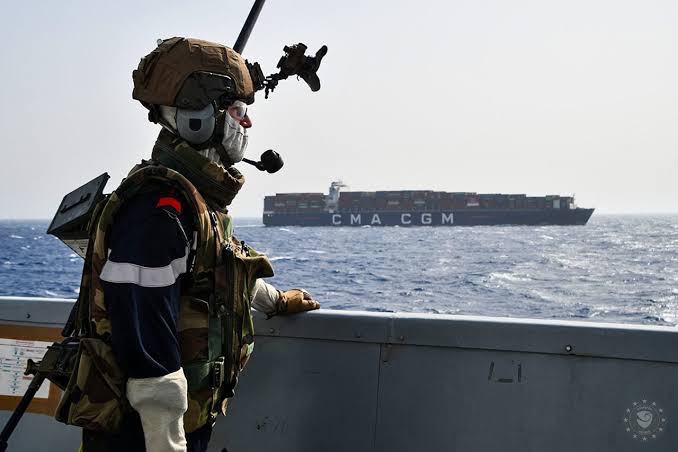
A regional diplomatic push to restore safe passage through one of the world’s most strategically critical shipping lanes deserves close attention from every stakeholder in global trade.
The Red Sea and the Bab el-Mandeb Strait together form one of the most consequential chokepoints in world trade. Roughly ten to twelve percent of global seaborne cargo passes through this corridor annually, connecting Asian export economies with European consumers and linking the Gulf’s energy producers to markets worldwide. When that corridor is compromised, the commercial and operational consequences are felt across every segment of shipping — from VLCC operators to container lines, from bulk carriers to LNG tankers. The news that Saudi Arabia has assembled a coalition of fourteen nations with the explicit aim of protecting Red Sea shipping lanes is, therefore, not merely a geopolitical footnote. It is a development with direct implications for vessel routing, war risk insurance, charter party negotiations and fleet deployment strategies.
What Is Being Proposed and Why It Matters Now
The formation of a multi-nation coalition under Saudi leadership to safeguard Red Sea passage signals a regional recognition that the threat to commercial shipping in this area has become structurally disruptive rather than episodic. For well over a year, attacks on merchant vessels transiting the southern Red Sea have forced operators to make a stark choice: accept elevated war risk exposure or divert around the Cape of Good Hope, adding roughly ten to fourteen days of steaming time and significant additional bunker costs per voyage.
The involvement of fourteen nations suggests that the coalition carries meaningful political weight in the region. A Saudi-led grouping with that breadth of participation would have the potential to combine naval escorts, maritime domain awareness, intelligence sharing and diplomatic pressure in ways that no single state — or even a Western-led naval task force — can achieve unilaterally. The regional dimension matters: states with geographic proximity to the threat have both greater incentive and, in some cases, greater leverage than distant partners.
For the commercial shipping community, the critical question is not whether this coalition is diplomatically impressive, but whether it translates into genuinely safer transits. On that measure, the announcement is an important signal, but professional caution is warranted until operational effect is demonstrated on the water.
The Commercial Damage Has Been Substantial
To understand why this coalition matters, it is worth recalling the scale of disruption that has already accumulated. Container shipping through the Suez Canal corridor dropped dramatically following the onset of attacks, with several of the world’s largest liner operators rerouting their services around Africa. That rerouting absorbed significant vessel capacity — effectively tightening the market — while simultaneously inflating voyage costs. War risk insurance premiums for Red Sea transits reached levels not seen in modern commercial shipping, in some cases adding hundreds of thousands of dollars to a single voyage cost.
Bulk carrier and tanker operators faced similar pressures. Voyage economics that had been carefully modelled against Suez Canal transits were suddenly unworkable, forcing last-minute charter amendments, speed adjustments and cargo delivery delays that cascaded through supply chains. Port congestion at alternative routing hubs added further friction.
The cumulative effect has been a persistent premium embedded in freight rates and cargo insurance, a structural disruption that has lasted far longer than most market participants anticipated when the threat first emerged. Any credible initiative that reduces this premium deserves serious commercial attention.
What Owners, Operators and Masters Should Watch For
From an operational standpoint, a coalition announcement does not immediately change passage risk assessments. Masters, company security officers and designated persons ashore should continue to apply the same rigorous Best Management Practice protocols that have governed Red Sea transits throughout this period. The following considerations remain live:
- War risk insurance: Underwriters will not adjust premiums on the basis of a political announcement alone. They will require sustained evidence of reduced incident frequency and credible interdiction capability before any meaningful premium reduction is offered. Owners should monitor this closely but not anticipate rapid relief.
- Charter party war risk clauses: Any voyage or time charter touching on Red Sea routing should be reviewed in light of the current insurance and operational environment. The coalition’s formation does not yet trigger a material change in the legal landscape around war risk addenda.
- Routing decisions: The Cape diversion remains the lower-risk option for many operators. A coalition announcement does not justify reverting to Suez routing without updated guidance from flag states, P&I clubs, and company security assessments.
- Crew welfare and safety: The human cost of operating in contested waters must not be subordinated to commercial pressure. Masters retain ultimate authority over the safety of their vessels and crews, regardless of commercial incentives to transit.
The Broader Strategic Picture
There is a wider dimension to this coalition that shipping professionals should not overlook. Saudi Arabia’s active leadership of a regional maritime security effort represents a meaningful shift in how Gulf states are approaching their strategic interests. For decades, maritime security in the Red Sea and Gulf of Aden was largely underwritten by Western naval presence, with regional states as beneficiaries rather than architects of that security architecture. A Saudi-led coalition of fourteen nations suggests a more assertive regional posture.
Whether this translates into durable security will depend on factors well outside the shipping industry’s control: political settlements, diplomatic engagement with all parties to the conflict that has generated the maritime threat, and the coherence and resourcing of the coalition’s naval component. History suggests that maritime security coalitions are most effective when they combine credible enforcement capability with a parallel political process that addresses the underlying drivers of the threat. One without the other tends to produce temporary suppression rather than lasting resolution.
For shipping, the medium-term outlook has nevertheless improved at the margin. A regionally anchored coalition with Saudi leadership carries political legitimacy in contexts where Western-led operations do not. That legitimacy may prove important in securing cooperation from states that have thus far been ambivalent about interdiction efforts.
Implications for Freight Markets and Chartering
Chartering professionals should track this development as a potential inflection point in market dynamics, without pricing it in prematurely. If the coalition demonstrates operational effect over the coming months — measurably reducing attack frequency and severity — the progressive normalisation of Red Sea routing could release the absorbed vessel capacity that has been supporting freight rates in certain segments. Container freight rates in particular have benefited from the effective removal of Red Sea capacity; a safe return to Suez routing would reintroduce that capacity into the market with corresponding rate pressure.
For voyage charterers and cargo interests, the ability to contract on shorter, Suez-routed voyages would reduce freight cost and improve scheduling certainty. This is a commercially significant prospect that fixture negotiations in the coming months should account for as a contingency — not yet as a baseline assumption.
Final Thoughts
Saudi Arabia’s fourteen-nation coalition is, for now, more the latter than the former. That is not a dismissal — political narrative in this region can shift operational realities with considerable speed when backed by genuine commitment and resources.
What can be counseled from this: maintain current risk management protocols, watch for concrete evidence of reduced incident rates, and position your chartering and insurance strategies to respond quickly when — and if — underwriters and flag state advisories begin to reflect an improved security environment. The Red Sea corridor is too commercially important to ignore, and too dangerous to rush back into on the basis of diplomatic optimism alone. This coalition is a meaningful step. Whether it is a decisive one remains to be seen.