The Middle East’s secondary export route is now exposed to the same conflict risk that made it necessary in the first place.
Introduction
A voyage plan normally offers alternatives. When one route becomes unsafe, the ship diverts, the commercial department recalculates the voyage and the cargo still moves—later and at a higher cost, but within a familiar operating framework.
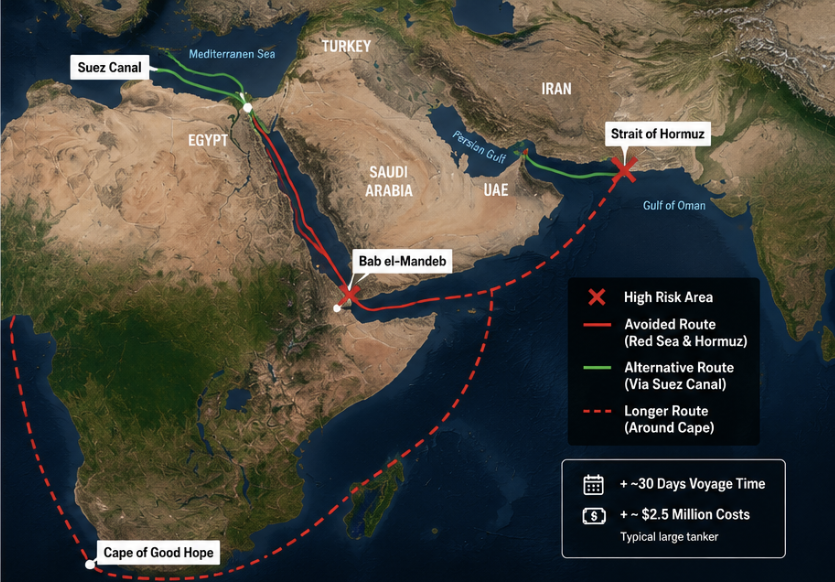
The present Middle East situation is more serious because the alternative itself has become vulnerable. Disruption around the Strait of Hormuz pushed more Saudi energy exports toward Red Sea terminals such as Yanbu. Those cargoes could then sail south through Bab el-Mandeb toward Asian markets. Renewed Houthi threats and attacks against Saudi-linked shipping have weakened that fallback, forcing some tankers to turn north toward Suez and then sail around the Cape of Good Hope to reach Asia.
This is no longer a simple diversion story. It is a case of two linked chokepoints becoming unsafe at the same time, leaving owners, charterers and masters with choices that are operationally possible but commercially severe.
The Fallback Route Is Now Exposed
Saudi Arabia has an advantage unavailable to several neighbouring exporters: its east-west pipeline can move crude from the Gulf side to Red Sea terminals. On paper, that creates a valuable escape route—load at Yanbu, sail through the Red Sea, pass Bab el-Mandeb and continue into the Gulf of Aden.
The weakness is geographical. Bab el-Mandeb is the southern gate of the Red Sea. After the Houthis declared a naval blockade against Saudi Arabia, five tankers changed course in the Red Sea in one day, while others reportedly waited for instructions. Several Saudi crude carriers had already made U-turns rather than continue toward the Yemeni coast.
The strategic lesson is straightforward: an alternative route does not provide genuine resilience when it remains exposed to the same regional escalation.
What Vessels Are Actually Doing
The rerouting is no longer theoretical. Torm confirmed that the product tanker Torm Innovation, carrying approximately 500,000 barrels of naphtha from Yanbu to Japan, would proceed north through Suez and then around the Cape rather than transit the southern Red Sea.
On a chart, that route looks commercially illogical because the vessel first sails away from Asia. Operationally, however, it avoids the immediate Bab el-Mandeb threat. The ship enters the Mediterranean through Suez, exits through Gibraltar, rounds Africa and then heads east.
This is the point at which distance becomes secondary to risk. The shortest route has little value if the threat assessment, insurer or company security policy makes it unacceptable.
The Commercial Penalty Builds Quickly
The cost is not one isolated surcharge. It is a stack of penalties.
A Yanbu-to-Taiwan voyage normally taking about 19 days via Bab el-Mandeb could take approximately 48 days through Suez, Gibraltar and the Cape. In the example calculated by Reuters, fuel costs increased from approximately $1.26 million to $2.87 million, before adding roughly $1 million in Suez Canal charges.
Another industry estimate cited around 10,000 additional nautical miles, 34 extra sailing days and more than $5 million in added freight costs, excluding fuel and insurance. Actual figures will vary with vessel size, speed, bunker prices, charter terms and waiting time, but the commercial direction is clear.
The longer voyage also removes the vessel from the market for several additional weeks. The cargo may miss refinery or storage windows, the ship’s next employment may be lost, and replacement tonnage becomes more difficult to secure.
The effect therefore extends beyond one cargo. It reduces effective fleet supply, disrupts vessel positioning and can tighten freight markets across trades that were not directly involved in the original diversion.
Suez Is an Outlet, Not a Complete Substitute
The Suez option has physical constraints. Large tankers may be unable to transit fully laden and may require partial loading, cargo transfer or pipeline support. Larger vessels could have to pass through Suez partly loaded and top up in the Mediterranean, potentially using Egypt’s SUMED pipeline.
SUMED is valuable infrastructure, but it does not create unlimited replacement capacity. Reuters reported pipeline capacity of approximately 2.5 million barrels per day, compared with Saudi oil exports of around 7 million barrels per day.
This is where geopolitical shipping analysis often becomes too simplistic. Drawing an alternative line on a map does not prove that the route can absorb the displaced trade.
Draft limits, pipeline throughput, terminal schedules, tanker availability, cargo compatibility and destination economics must all work together. A technically available route can still be commercially inadequate.
Voyage Planning Becomes a Joint Risk Decision
The master retains professional responsibility for the safety and security of the ship, but a transit decision of this scale cannot be treated as a bridge-only matter. It requires coordination among the owner, ship manager, charterer, cargo interests, security advisers, flag State, P&I club and war-risk underwriters. IMO’s SOLAS framework recognises the master’s overriding professional judgement in decisions necessary to maintain ship safety and security.
Before voyage orders are issued or accepted, the parties should establish:
- whether the ship is exposed because of its flag, ownership, management, cargo origin, recent port calls or trading history;
- whether war-risk cover remains available and what exclusions, additional premiums or cancellation rights apply;
- whether the intended draft permits Suez transit or requires partial loading or cargo transfer;
- whether bunkers, stores, spares and crew arrangements can support several additional weeks at sea;
- who bears the additional time, fuel, canal dues, security costs and deviation consequences.
These are not matters to settle after departure. They determine whether the voyage is both physically safe and commercially executable.
Charterparty wording will be tested heavily. Owners may consider a transit unsafe while charterers continue to press for performance. Disputes may then arise over deviation, off-hire, additional premiums, bunker consumption and compliance with employment orders.
Clear written risk assessments and timely communication are therefore as important as the route calculation itself.
Security Measures Must Remain Vessel-Specific
Advice to reduce a vessel’s electronic footprint may be relevant in a targeting environment, but it should not become a casual instruction to switch off AIS. IMO guidance recognises the master’s discretion where continued AIS operation could compromise security, while AIS remains an important part of safe navigation and traffic awareness.
The wider principle is more important: security instructions must be documented, vessel-specific and integrated into the passage plan.
A generic circular cannot account for traffic density, visibility, bridge workload, naval coordination, machinery condition, cargo characteristics and the ship’s individual threat profile.
IMO has condemned the renewed attacks in both the Red Sea and Strait of Hormuz and has urged operators not to expose seafarers to unnecessary danger where credible security guarantees are absent. Commercial pressure cannot make an unsafe transit safe.
What the Industry Should Watch
The next indicator is not simply whether a chokepoint is formally declared open or closed. The industry should watch actual vessel behaviour: ships holding position, reversing course, slow steaming, declining fixtures or changing declared destinations.
These decisions reveal how owners, insurers and security advisers are assessing the threat before formal policy announcements are issued.
Insurance will be equally important. Reuters reported that war-risk costs through the southern Red Sea doubled for some companies after the latest incidents. If underwriters restrict cover for Saudi-linked cargoes or vessels with recent Saudi port calls, avoidance may continue even without a formally declared closure.
The market must also watch the cumulative effect on tanker availability. Every additional month spent completing a diverted voyage is a month during which that vessel cannot accept another cargo. Even when physical oil supply remains available, transport capacity can become the limiting factor.
Final Thoughts
Shipping is accustomed to pricing one blocked chokepoint. It handles the loss of the fallback route far less comfortably.
Hormuz disruption can be partly mitigated through Saudi Red Sea exports. Bab el-Mandeb risk can be avoided by sailing north through Suez and around the Cape. But when both risks operate together, the remaining solution is not efficient redundancy—it is a long, expensive and capacity-constrained detour.
The correct professional response is not to search for a clever shortcut. There is none.
Owners and charterers must price the full voyage consequence, managers must prepare ships for extended employment, and masters must be protected from pressure to accept a transit that the current threat picture does not justify.
The safest route may still be available. It is simply no longer cheap.