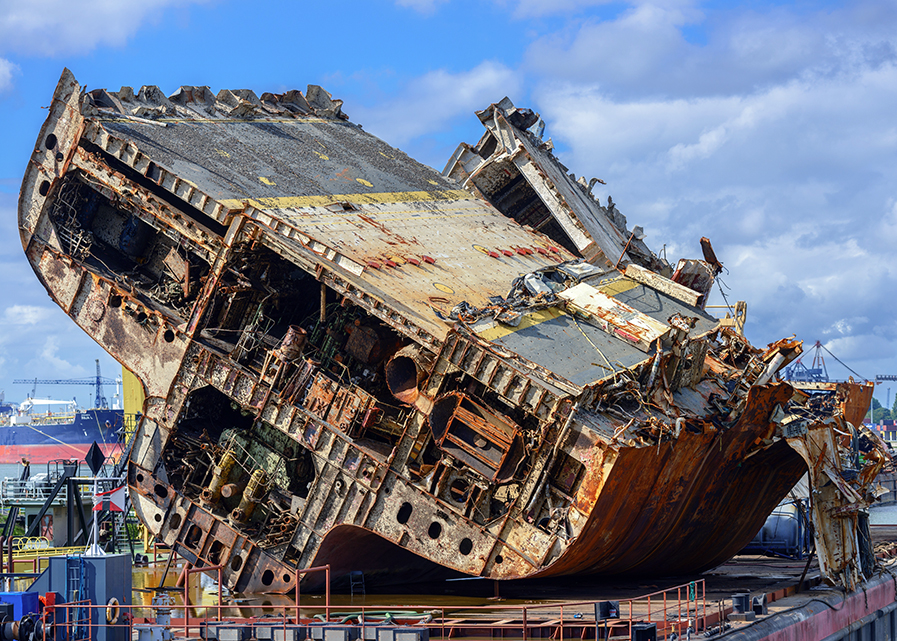
For decades, ship recycling was largely treated as the final commercial transaction in a vessel’s life. Once continued operation became uneconomical, the owner obtained demolition offers, selected a buyer and delivered the ship to a recycling destination.
That approach is no longer sufficient.
The Hong Kong International Convention for the Safe and Environmentally Sound Recycling of Ships entered into force on 26 June 2025, establishing mandatory international requirements covering ships, recycling facilities, certification, inspections and enforcement.
The practical consequence is significant: responsible recycling must now be prepared for long before the vessel reaches its final voyage.
The Vessel Must Be Recycling-Ready
The Convention addresses the vessel throughout its operating life, not only after it has been sold for demolition.
One of its central requirements is the Inventory of Hazardous Materials, commonly known as the IHM. This vessel-specific document identifies hazardous materials contained in the ship’s structure and equipment.
These may include asbestos, ozone-depleting substances, polychlorinated biphenyls and restricted anti-fouling compounds. The Convention prohibits or restricts certain hazardous materials and requires their presence to be properly identified.
An IHM should not be treated as a certificate prepared once and forgotten. It is a controlled technical record that must reflect relevant changes made during the vessel’s life.
When equipment, insulation, coatings, gaskets, cables or machinery components are renewed, the supporting material declarations must be retained and the inventory updated where necessary.
A ship may therefore be fully operational yet poorly prepared for recycling if its technical records have not been properly maintained.
The Final Sale Requires More Than the Highest Offer
The highest demolition price is not automatically the best commercial outcome.
Before agreeing to a recycling sale, the owner must consider whether the intended facility is properly authorised and capable of handling the vessel safely. The ship’s documentation, hazardous-material information and final condition must also support the recycling process.
The Convention distributes responsibilities across shipowners, flag States, port States, recycling States and ship-recycling facilities. Its framework includes surveys, certification, facility authorisation, inspection and reporting.
This means the owner must conduct genuine due diligence rather than relying solely on the assurances of a cash buyer or intermediary.
A commercially attractive offer can create serious exposure when the delivery destination, recycling facility or contractual chain cannot withstand regulatory scrutiny.
The IHM Is Now a Commercial Document
The Inventory of Hazardous Materials is often viewed as a technical or class-related obligation. In practice, it can directly affect the vessel’s residual value and the speed of a recycling transaction.
An incomplete or poorly maintained IHM may lead to additional inspections, sampling, documentation work and negotiation before delivery. It may also create uncertainty for the recycling facility when preparing the ship-specific recycling plan.
Owners should therefore include IHM management within their normal purchasing and maintenance procedures.
When new equipment is supplied, the documentation package should include the relevant material declarations and supplier declarations of conformity. These records must be controlled in the same way as drawings, certificates and equipment manuals.
Without that discipline, the technical department may face a major reconstruction exercise when the vessel approaches sale.
Recycling Preparation Begins Before the Last Voyage
A vessel sold for recycling must still remain safely operable during its final voyage.
Machinery, navigation equipment, lifesaving appliances and fire-safety systems cannot be neglected simply because the ship is approaching the end of its commercial life. The vessel remains subject to flag, class and port-State requirements until it is formally withdrawn from service.
At the same time, the owner must prepare the vessel for safe handover.
Residual fuel, lubricants, chemicals, sludge, stores and pressurised systems require careful control. Tanks and spaces must be accurately documented. Loose equipment and remaining hazardous substances must be declared rather than left for the recycling yard to discover.
The final voyage is therefore both an operational passage and a controlled transition from trading ship to recycling asset.
Compliance Will Affect Recycling Economics
The Convention does not remove commercial competition from ship recycling. It changes what must be considered when comparing offers.
A proper evaluation should include:
- The proposed recycling facility
- The vessel’s certification status
- The completeness of the IHM
- Required pre-delivery work
- Voyage and delivery costs
- Remaining bunkers and consumables
- Taxes, duties and agency expenses
- Payment security
- Contractual responsibility if the nominated yard changes
- Potential reputational and regulatory exposure
A higher price per lightweight tonne can quickly lose its advantage when delays, documentation failures or delivery complications arise.
The stronger transaction is the one that provides a secure payment structure, an acceptable facility and a clear compliance pathway from sale to final recycling.
What Owners Should Do Now
Owners should not wait until a ship appears on the demolition list before reviewing its recycling readiness.
Each vessel should have:
- A complete and current IHM.
- Supporting supplier and material declarations.
- Clear responsibility for updating the inventory.
- Periodic verification during major repairs and conversions.
- A controlled process for selecting recycling buyers and facilities.
- Contractual protections preventing unauthorised changes to the recycling destination.
- A final-voyage and handover plan.
Older vessels require particular attention because historical material records may be incomplete. The longer the documentation gap is allowed to remain, the more expensive and disruptive it may become to correct.
Final Thoughts
The Hong Kong Convention changes ship recycling from a loosely controlled final sale into a documented compliance process.
Owners that maintain accurate records and plan early should be able to manage the transition without unnecessary disruption. Owners that leave everything until the demolition decision may discover that the vessel’s final transaction is more complicated than expected.
A ship’s commercial life may end at the recycling yard, but responsible recycling begins years before arrival.