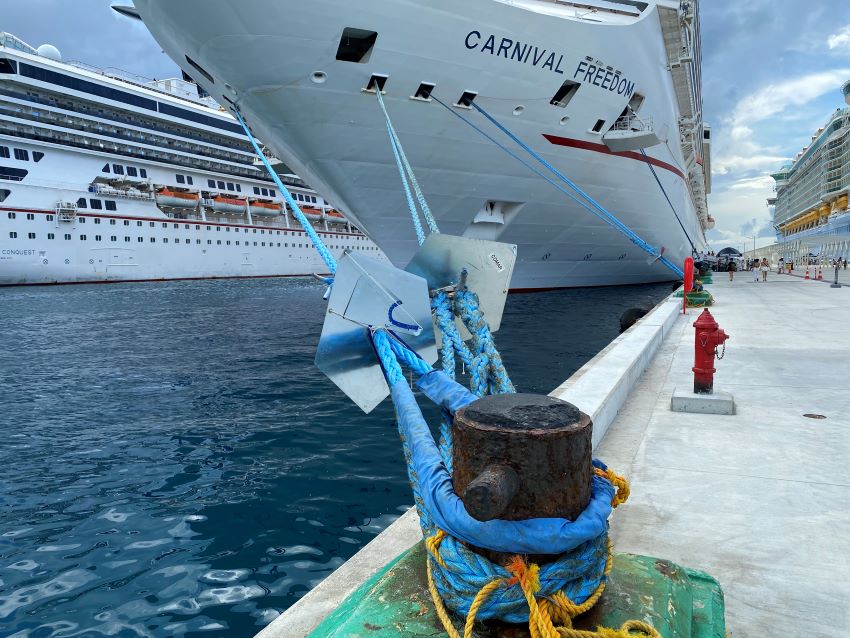
Mooring is a routine operation with fatal consequences when line condition, crew positioning or communication is poorly controlled.
Mooring is one of the most familiar operations carried out on board a ship. It happens in almost every port, often under commercial pressure, with pilots, tugs, terminals and agents all waiting for the vessel to come alongside.
That familiarity is precisely what makes mooring dangerous.
A crew may complete hundreds of berthings without a serious incident. Gradually, the operation begins to feel routine. Snap-back zones are treated casually, damaged ropes remain in service, communication becomes informal and crew members stand where experience tells them they have “always been safe.”
Then one line parts, a winch renders unexpectedly or the vessel surges away from the berth. Within seconds, a normal operation becomes a major casualty.
The central lesson is simple: a mooring line is not merely a rope. It is a tensioned energy-storage system.
The Energy Stored in a Mooring Line
When a mooring line is placed under tension, it stretches. That stretch stores energy.
Synthetic ropes can store substantial elastic energy, particularly when heavily loaded. If the line parts or slips from a fitting, that energy is released violently. The recoiling line may travel across the mooring deck with enough force to cause fatal injuries.
The danger is not limited to a clearly marked line directly behind the rope. A parted line may recoil unpredictably depending on:
- The type and condition of the rope
- The point at which it fails
- The lead of the line
- The position of rollers, fairleads and bitts
- The vessel’s movement
- The amount of tension at the time of failure
This is why relying only on painted snap-back markings can create a false sense of security. The safest approach is to treat the wider mooring deck as a potential danger area whenever lines are under load.
Line Condition Must Be Judged, Not Assumed
A mooring rope may look acceptable from a distance while having already lost a significant part of its strength.
Common warning signs include glazing, flattened sections, broken fibres, hard spots, chemical contamination and excessive abrasion. Particular attention should be given to the sections that repeatedly pass through fairleads, around rollers or onto winch drums.
The rope’s age alone does not determine whether it is fit for service. A relatively new line can be weakened by poor storage, incorrect spooling, heat damage or repeated shock loading. An older line may remain serviceable when properly maintained and used within its limits.
The critical question is not simply, “Is the rope broken?”
It is, “Can this rope still safely withstand the load that may develop during this operation?”
A responsible inspection must consider the complete mooring arrangement, including tails, shackles, stoppers, rollers, fairleads, bitts and winch drums. The system is only as strong as its weakest component.
Poor Line Leads Create Hidden Loads
A line that appears correctly secured may still be working inefficiently.
Sharp leads, seized rollers and incorrect fairlead selection increase local stress and friction. A rope rubbing against an unsuitable surface may experience rapid heat generation and abrasion. Unequal line leads can also cause one line to carry a disproportionate share of the vessel’s load.
This becomes particularly dangerous when several lines serving the same function have different materials, lengths or elastic characteristics.
For example, two breast lines may appear equally tight, but the stiffer line may be carrying most of the load. The softer line may remain visually tensioned while contributing far less than expected. If the heavily loaded line fails, the remaining line may be suddenly shock-loaded and fail immediately afterwards.
A mooring arrangement should therefore be assessed as a balanced system, not as a collection of individual ropes.
Winch Brakes Are Safety Devices
The mooring winch brake is often treated as a simple holding mechanism. In reality, it is an essential safety device designed to hold the vessel while also protecting the line and equipment from excessive load.
If the brake is set too tightly, the line may part before the winch renders. If it is set too loosely, the line may pay out unexpectedly, allowing excessive vessel movement.
Brake testing and correct brake setting are therefore fundamental. The crew must understand the brake’s holding capacity and how that capacity relates to the strength of the line being used.
Painting a mark on the brake handle is not, by itself, proof that the brake is correctly set. Brake condition can change because of wear, contamination, corrosion, lining deterioration or poor adjustment.
Testing must be supported by proper maintenance and accurate records.
Communication Failures Remain a Major Risk
Most mooring accidents are not caused by one dramatic technical failure. They develop through several smaller failures happening together.
A crew member does not hear an instruction. The officer assumes the line is clear. The winch operator heaves before receiving confirmation. The bridge orders the engine ahead while the mooring station is still adjusting a line.
Clear communication is therefore essential between:
- The bridge and mooring stations
- The officer in charge and winch operators
- Forward and aft stations
- The ship and terminal personnel
- The ship, pilot and tug operators
Orders should be brief, standardised and acknowledged. When an instruction is unclear, the operation should pause.
The pressure to berth quickly must never override the requirement to understand what is happening on deck.
The Officer in Charge Must Control the Deck
The officer supervising the mooring station should not become another pair of hands unless absolutely necessary. Their primary task is to maintain an overview.
That includes monitoring:
- Crew positions
- Line leads and tension
- Winch operation
- Communication with the bridge
- Movements of shore personnel
- Changes in wind, current and vessel position
- Developing hazards around the mooring deck
Once the supervising officer becomes physically occupied with handling ropes or operating equipment, situational awareness may be lost.
Good supervision requires enough distance to see the full operation and enough authority to stop it immediately.
Complacency Is More Dangerous Than Inexperience
An inexperienced crew member may be cautious because they recognise the danger. An experienced crew member may stand in an unsafe position because they have done so many times without consequence.
Statements such as “we always do it this way” should be treated as warning signs.
Experience is valuable only when it improves judgement. When experience produces shortcuts, familiarity and overconfidence, it becomes a liability.
Before every mooring operation, the team should discuss the expected sequence, individual responsibilities, line plan, weather conditions, tug use and any unusual risks. The discussion does not need to be long, but it must be specific to the operation.
A generic toolbox talk signed without discussion provides paperwork, not protection.
Practical Controls That Matter
A safe mooring operation depends on consistent discipline:
- Inspect all lines and mooring equipment before arrival.
- Confirm that rollers and fairleads move freely.
- Review the intended mooring arrangement with the bridge team.
- Keep personnel away from loaded lines and bights.
- Avoid standing between a line and the ship’s side.
- Maintain clear communication and acknowledged commands.
- Do not mix ropes with significantly different characteristics for the same function.
- Monitor line tension continuously after berthing.
- Stop the operation when the situation is unclear.
- Report and investigate near misses, not only accidents.
These controls are basic. Their effectiveness depends entirely on whether they are followed when the vessel is under pressure.
Final Thoughts
Mooring accidents rarely occur because the crew did not know that ropes can part. They occur because the danger was recognised in theory but underestimated in practice.
A mooring deck demands the same level of professional attention as an engine-room manoeuvring condition, cargo operation or enclosed-space entry. The loads may not be visible, but they are present in every tensioned line.
The most experienced seafarer on the mooring deck is not the person who works fastest or stands closest to the rope.
It is the person who recognises when the operation is becoming unsafe—and stops it before the line decides for them.