Renewed Houthi attacks have turned insurance into one of the biggest costs—and decisions—behind a Red Sea transit.
To someone outside shipping, the idea sounds almost absurd.
A ship worth $100 million could theoretically face an additional $3 million insurance charge for a single high-risk voyage if quoted at a 3% war-risk premium.
Yet that is the scale of risk now appearing in parts of the Red Sea.
Following renewed Houthi attacks on shipping this week, indicative additional war-risk premiums for voyages through the southern Red Sea rose above 1% of a vessel’s value, compared with around 0.3% only a week earlier. For some Saudi-linked vessels and ships calling at southern Saudi ports such as Jizan and Al Shuqaiq, quotes reportedly reached as high as 3% of hull value.
This is not simply an insurance story.
It affects whether a vessel sails, which route it takes, whether a charter remains commercially viable, what freight rate the owner requires and ultimately how much it costs to move energy and goods around the world.
What Changed This Week?
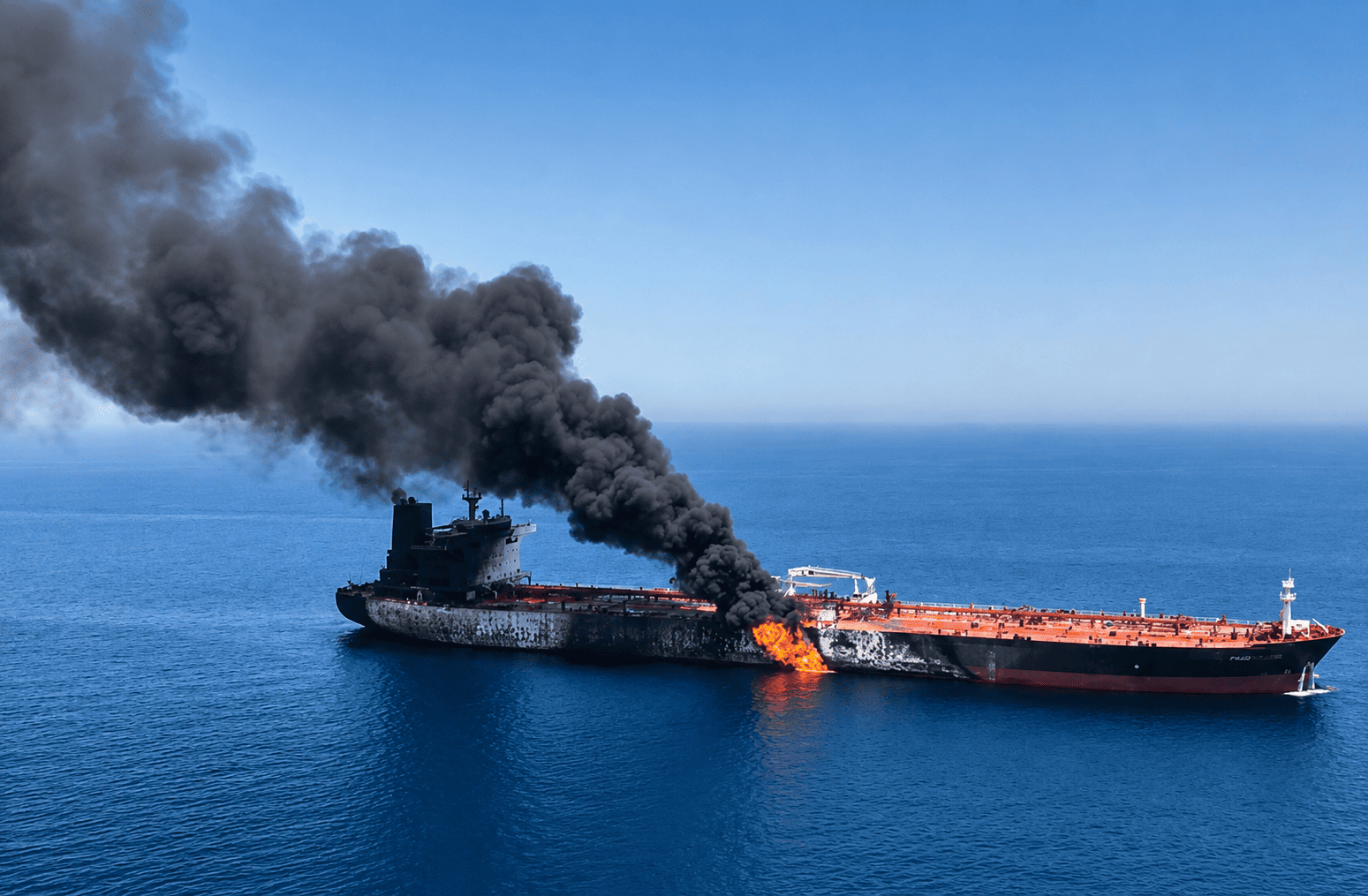
On 23 July, maritime-security sources confirmed that the Saudi tanker Encelia had been struck near Jizan, close to Yemen, with a fire reported on the vessel. The Houthis also claimed an attack on another tanker, Layla, although Reuters had not independently confirmed that second strike at the time of reporting.
The attacks followed a Houthi announcement of a naval blockade targeting Saudi Arabia.
The reaction from shipping was immediate.
Days before the confirmed strike, tanker movements had already begun changing. Five tankers altered course in the Red Sea on 22 July, while other vessels held position or moved north toward Suez rather than continuing south through Bab el-Mandeb.
On 23 July, the International Maritime Organization condemned the renewed attacks and specifically called on ship operators to carry out thorough risk assessments before transiting the region.
The shipping industry therefore faces an uncomfortable question:
How much financial risk is acceptable when the physical risk to the ship and crew is also increasing?
Why Can Insurance Cost So Much for One Voyage?
Ships normally carry extensive insurance arrangements throughout the year.
But ordinary hull insurance does not mean a vessel can simply enter every conflict zone at no additional cost.
When a vessel enters an area where war, missiles, mines, terrorism, piracy or similar dangers have increased substantially, insurers may demand an Additional War Risk Premium, commonly referred to within the industry as an additional premium.
The amount reflects the insurer’s assessment of exposure.
That assessment may consider:
- Vessel value
- Ship type
- Flag
- Ownership and management links
- Cargo
- Previous port calls
- Destination
- Route
- Time spent inside the risk area
- Current intelligence
- Recent attacks
This explains why insurance pricing can be dramatically different even within the same sea.
Reuters reported quotes around 0.1% for some voyages involving northern Saudi Red Sea ports such as Jeddah and Yanbu, while certain southern Saudi and Saudi-linked exposures were quoted as high as 3%.
In modern maritime security, geography can change an insurance bill by millions of dollars.
What Does 3% Actually Mean?
Consider a simplified example.
A tanker with an insured hull value of $100 million receiving a war-risk quote of 3% would face:
$3 million in additional premium.
For a single exposure.
That is before considering:
- Bunker consumption
- Port expenses
- Canal dues
- Crew war-risk bonuses
- Security costs
- Financing costs
- Normal vessel operating expenses
Reuters noted that even relatively small movements in war-risk rates can add hundreds of thousands of dollars to the cost of a seven-day voyage.
This is why the owner cannot treat insurance as an accounting detail handled after fixing the cargo.
It must become part of the voyage decision itself.
The Alternative Route Is Not Cheap Either
An owner confronted with unacceptable Red Sea exposure may appear to have a simple solution:
Reroute.
Commercially, it is rarely that simple.
Recent tanker movements demonstrate the problem clearly.
Ships lifting Saudi crude from Yanbu that would normally head south through Bab el-Mandeb toward Asian markets can instead proceed north through the Suez route. But Reuters reported that such a change could add roughly 10,000 nautical miles and 34 sailing days, with more than $5 million in additional estimated freight costs, excluding fuel and insurance. Suez Canal costs could add approximately another $1 million per vessel.
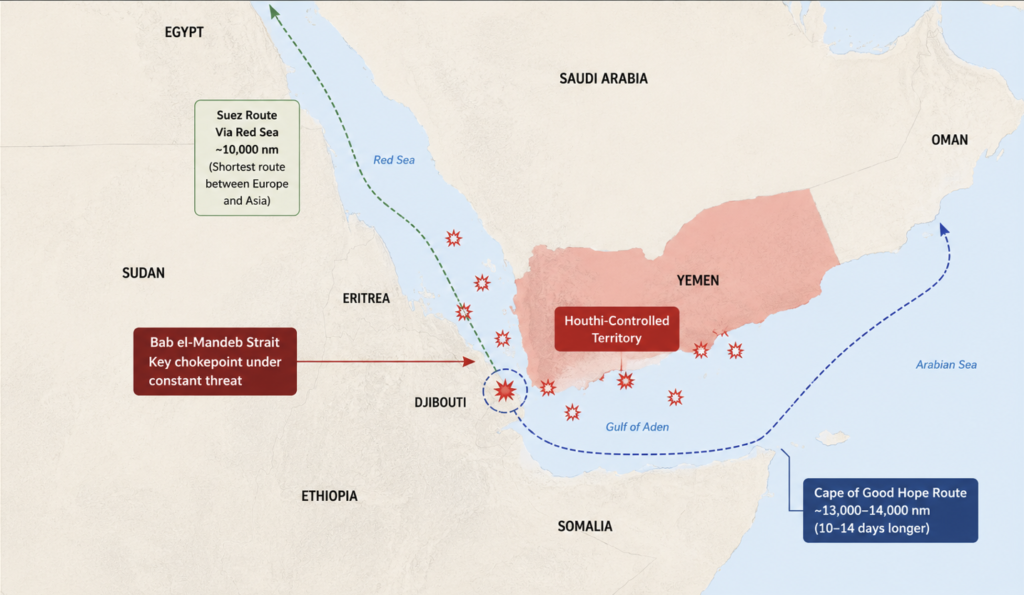
So an operator may face two extremely expensive choices:
Transit the higher-risk area and pay increased insurance—or reroute and absorb additional voyage time and cost.
Neither option is commercially neutral.
This Is Why Freight Rates Can Move So Quickly
To outsiders, tanker freight rates can appear irrational.
A voyage that cost one amount last month can suddenly become dramatically more expensive even though the ship, cargo and ports have not changed.
The reason is that vessel supply is measured not only by how many ships exist, but by how many are available in the correct place and willing to perform the voyage.
When security deteriorates:
Ships reroute.
Some owners refuse the voyage.
Others demand higher freight.
Voyages take longer.
Insurance increases.
Effective vessel availability falls.
A tanker spending another month completing a longer route is unavailable for another cargo during that period.
Geopolitical disruption can therefore tighten vessel supply without removing a single ship from the world fleet.
Who Actually Pays the War-Risk Premium?
This becomes a charterparty question.
Under BIMCO’s updated CONWARTIME 2025 time-charter clause, where a vessel proceeds into an area exposed to war risks, charterers are generally required to reimburse defined insurance costs actually incurred, subject to the clause’s terms. The provision also allows owners or the master to avoid an area considered dangerous under the contractual test.
BIMCO’s VOYWAR 2025 for voyage charters similarly addresses additional insurance costs and the financial consequences of alternative routing arising from war risks.
But actual responsibility always depends on the charterparty in force.
Owners and charterers therefore need to examine:
- War-risk clauses
- Trading limits
- Additional premium provisions
- Crew bonus clauses
- Deviation rights
- Freight-adjustment mechanisms
- Unsafe-area provisions
- Supporting insurance documentation
When premiums were relatively small, disagreements could sometimes be commercially absorbed.
At 1%, 2% or 3% of vessel value, that becomes much harder.
The Master’s Decision Still Comes Before the Insurance Decision
There is a dangerous way to look at this situation:
“If the insurer is willing to cover the ship, the voyage must be acceptable.”
That is incorrect.
Insurance transfers part of the financial exposure. It does not remove the physical threat.
A missile strike cannot be undone because the vessel has adequate cover.
The master and owner must still evaluate:
- Threat intelligence
- Vessel vulnerability
- Crew safety
- Routing
- Emergency response capability
- Naval guidance
- Flag-State instructions
- Company security procedures
The IMO’s latest statement is particularly important for this reason. Its focus was not on how much the voyage costs to insure, but on protecting the seafarers being placed in the danger zone.
The final decision must remain a safety decision first.
Shipping Is Now Managing Two Middle East Chokepoints
The timing makes the Red Sea escalation particularly serious.
The Strait of Hormuz has already experienced severe disruption and attacks on commercial vessels. The Red Sea and Bab el-Mandeb have historically provided an important alternative route for some Middle Eastern energy flows.
The renewed Houthi threat now means operators are simultaneously assessing exposure at two strategically critical maritime chokepoints. Reuters reported industry concern that the latest developments could restrict precisely the Red Sea routes that had become increasingly important during the disruption around Hormuz.
For shipping companies, this changes the problem from route optimisation to network resilience.
There may simply be no cheap alternative.
The Cost Eventually Moves Beyond Shipping
War-risk insurance is paid within the shipping industry, but the economic effect does not necessarily remain there.
Higher voyage costs can eventually be reflected in:
- Freight rates
- Commodity prices
- Energy transportation costs
- Inventory requirements
- Delivery schedules
- Supply-chain risk premiums
The exact impact differs between trades and contracts, but the principle is straightforward.
When moving a cargo becomes more dangerous and ships spend longer completing voyages, transportation capacity becomes more expensive.
That cost must ultimately be absorbed somewhere within the commercial chain.
What Owners and Operators Should Be Doing Now
The immediate priority should not be chasing the cheapest insurance quote.
Companies should continuously review the complete exposure:
Security intelligence: Has the threat profile changed since the fixture was concluded?
Insurance: What additional premium is actually available, and under what exclusions?
Charterparty: Who bears the additional premium and rerouting cost?
Crew: Are war-risk bonuses, consent requirements or nationality restrictions applicable?
Routing: Is the alternative genuinely safer and commercially viable?
Next employment: What effect will an additional 20 or 30 voyage days have on subsequent commitments?
Documentation: Have charterers been notified of additional costs where required?
A vessel can be fully insured and still undertake a poor commercial voyage.
It can also be commercially profitable and still present an unacceptable safety risk.
Professional management requires both questions to be answered separately.
Final Thoughts
War-risk insurance has always existed because shipping trades through regions where political instability and conflict can affect vessels.
What is extraordinary today is the scale.
When insurers begin quoting a percentage of the entire value of a ship for a short period of exposure, the market is sending a very clear signal about how dangerous it considers that voyage.
The public sees a tanker carrying oil through the Red Sea.
The shipping company sees something very different:
A vessel worth tens or hundreds of millions of dollars, a crew whose safety cannot be priced, a cargo commitment, a charterparty, several possible routes—and an insurance decision that can change by millions of dollars overnight.