
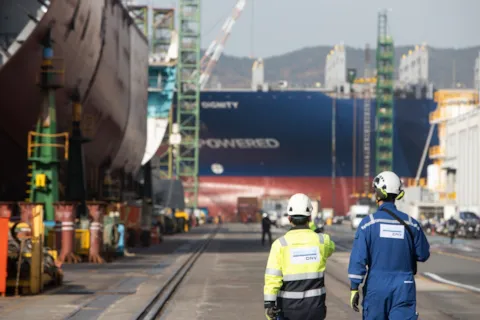
DNV’s new readiness notations shift future electrification from a vague design intention into something owners and yards can plan, document and class-review from the newbuilding stage.
A small rule change with a much bigger design message
DNV’s July 2026 edition of its Rules for Ships may not attract the attention of a major casualty or geopolitical disruption, but for owners planning vessels with 20- to 25-year operating lives, some of the changes are commercially significant.
The new edition will enter into force on 1 January 2027, following DNV’s publication of 92 rule and standard documents. Among the additions are two new class notations: Battery ready and Shore power ready. DNV has also introduced a new fatigue-life notation, revised its gas-fuelled hydrogen rules and made a series of structural, machinery and service-related changes.
The two “ready” notations deserve particular attention because they address one of the most difficult questions in newbuilding today:
How much should an owner spend now to prepare a vessel for technology that may only be installed years later?
That is no longer merely a sustainability question. It is increasingly a question of retrofit cost, regulatory exposure, trading flexibility and residual asset value.
What DNV has actually introduced
Under the July 2026 rules, DNV lists:
Battery ready — Pt.6 Ch.2 Sec.1
For vessels prepared for batteries as part of the main onboard energy installation.
Shore power ready — Pt.6 Ch.7 Sec.5
For vessels prepared for future shore-power installations.
The distinction between ready and installed is important.
A Battery ready vessel should not be interpreted as a battery-powered vessel. Likewise, Shore power ready does not mean the vessel already has an operational shore connection.
The purpose is preparation for a later installation.
That sounds simple, but in shipbuilding terms preparation can make the difference between a controlled future conversion and an expensive structural and electrical reconstruction.
What ‘Battery Ready’ means in practical newbuilding terms
Battery retrofits are rarely just a matter of finding space for a container full of cells.
A serious future installation can affect:
- weight and stability;
- structural foundations;
- electrical distribution;
- switchboards and protection;
- ventilation and cooling;
- fire detection and suppression;
- battery-management and power-management interfaces;
- cable routing;
- access for installation and replacement; and
- machinery-space or dedicated battery-room arrangements.
The exact class scope must, of course, be checked against the applicable DNV rule edition and the vessel-specific approval basis. But the engineering principle is straightforward: the cheaper time to accommodate these interfaces is while the vessel still exists on a drawing.
Once steel has been cut, cable trunks installed, switchboards selected and machinery spaces filled, every future modification becomes more difficult.
DNV already supports owners, designers and yards with battery feasibility, sizing, safety analysis, battery-room risk assessment and preparation for future retrofit. Its current battery guidance emphasises that maritime battery installations require proper consideration of fire, thermal runaway, ventilation and system safety rather than treating batteries as ordinary electrical equipment.
That is why the word ready matters.
It is not simply a marketing label. Properly used, it creates a defined engineering pathway between the vessel delivered today and a future hybridised vessel.
Why Battery Ready is appearing now
Battery technology is already established in ferries, offshore vessels and other duty cycles where frequent load changes, peak shaving or short-distance operation make electrification commercially attractive.
But wider adoption is still evolving.
At the same time, the international safety framework is developing. At IMO’s SSE 12 meeting in March 2026, work progressed on technology-neutral interim guidelines for ships using battery energy storage systems. IMO work is also continuing on amendments that would allow batteries to serve as a main source of electrical power under the SOLAS framework.
That leaves owners in a familiar shipping dilemma.
A newbuilding ordered in 2026 or 2027 may operate into the late 2040s or beyond, yet nobody can say with certainty what battery chemistry, fuel mix, carbon price or operating profile will be commercially dominant during that period.
Installing a large battery system today may not suit every ship.
Designing a vessel that makes future installation unnecessarily difficult is a different matter.
‘Shore Power Ready’ may become even more commercially relevant
Shore power presents a similar issue, but with a much clearer regulatory direction.
When connected to suitable port infrastructure, a ship can shut down or reduce the use of auxiliary engines and receive electrical power from shore. That can reduce local air pollution, noise, fuel consumption and emissions during port stays.
The challenge is that the vessel and port must be compatible.
A future conversion may involve connection equipment, switchboards, protection and interlocking systems, transformers, cabling, control logic and safe cable-handling arrangements.
On tankers, the problem is more complicated because the preferred connection location may interact with hazardous areas and cargo operations. DNV has previously highlighted the need to consider safe connection points, cable routing and explosion-risk controls when shore power is used on tankers.
Again, designing for these issues before delivery is fundamentally different from trying to create the space later.
Regulation is moving shore power from ‘green option’ toward operational requirement
This is where Shore power ready becomes commercially interesting.
DNV notes that shore power is moving from a voluntary environmental measure toward a compliance and operating consideration in several regions.
Under FuelEU Maritime, qualifying container and passenger ships will face requirements to use onshore power supply at specified EU berths from 1 January 2030, with the scope expanding further from 2035 where shore power is available, subject to defined exemptions.
That does not mean every ship needs shore power tomorrow.
A bulk carrier trading between terminals with no shore infrastructure may have a very different business case from a container vessel repeatedly calling major European ports.
But it does mean owners should stop asking only:
“Does my ship need shore power today?”
The better newbuilding question is:
“What will it cost me if this ship needs shore power ten years from now and I have made no allowance for it?”
That is the real value of a readiness notation.
The commercial issue: retrofit cost versus optionality
Shipowners have always paid for optionality.
We install spare cable ways, allow margins in electrical load calculations, reserve space for future equipment and specify structural capability beyond the immediate minimum where the commercial case justifies it.
Battery Ready and Shore Power Ready formalise that thinking around two technologies that could materially alter ship operation during the vessel’s life.
For an owner, the commercial benefits are not guaranteed. A notation does not automatically increase charter rates or resale value.
But it can demonstrate that future conversion was considered during design rather than left as somebody else’s problem.
For a prospective buyer, charterer or technical manager, that information can become useful when comparing two otherwise similar assets.
The real question is therefore not whether every vessel should carry the notation.
It is whether the cost of preparation during construction is reasonable compared with the potential cost and disruption of retrofitting later.
That calculation should be vessel-specific.
What owners and yards should decide before contract signing
Owners considering either notation should bring the discussion forward into the specification stage.
The wrong time to ask about Battery Ready is after the machinery-space arrangement has been frozen.
The wrong time to ask about Shore Power Ready is when the main switchboard is already ordered.
At minimum, the owner, designer, yard and class society should establish:
1. Intended future operating scenario
Is the battery intended for peak shaving, spinning reserve, hybrid propulsion or zero-emission port operation? Is shore power expected only occasionally or at every regular port call?
2. Physical space and access
Where will future equipment be installed, and can it actually be transported into that location without major structural removal?
3. Electrical architecture
Can the future installation be integrated into the selected voltage, switchboard and power-management arrangement?
4. Safety philosophy
Battery fire risk, ventilation, hazardous-area considerations and electrical isolation cannot be left for the retrofit contractor to solve ten years later.
5. Documentation
The value of readiness depends on the approved drawings, calculations and defined interfaces being retained throughout the vessel’s life.
That last point is routinely underestimated.
A ship may physically contain spare foundations and cable routes, but if nobody can later establish what they were designed for, much of the advantage is lost.
The other 2027 DNV changes should not be ignored
Battery and shore power are only part of the July 2026 update.
DNV has also introduced FL(Y,E) to state a vessel’s design fatigue life under specified operating conditions. The rules additionally revise the concept for gas-fuelled hydrogen to better align it with the IMO interim safety approach, while other changes address structural arrangements, direct structural analysis, gas-carrier capabilities and emission-related notations.
Taken together, these changes show where classification is moving.
Class is not simply checking whether today’s machinery and structure satisfy today’s requirements.
Increasingly, it is also providing frameworks through which future technology choices, design life and emissions capability can be documented before those features become operational necessities.
DNV also confirms that the July 2026 rules may be applied to projects contracted before 1 January 2027 where all parties agree.
For newbuildings already at specification or basic-design stage, that point is worth discussing with the yard and class society now rather than after contract design has been frozen.
Final Thoughts
The most important word in both notations is not battery or shore power.
It is ready.
Ships are expensive assets with long lives, while propulsion technology, port infrastructure and environmental regulation are changing much faster than the traditional vessel replacement cycle.
Owners cannot economically install every possible future technology at delivery. Nor should they.
But there is a major difference between postponing an investment and designing a vessel that makes the investment unnecessarily difficult later.
That is where these DNV notations have practical value.
For the right newbuilding, spending a relatively small amount of engineering effort today to preserve tomorrow’s options can be far more sensible than cutting steel twice.