
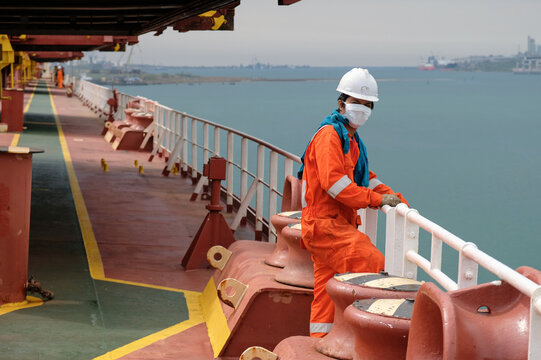
A junior sailor on a tanker earns roughly $1,500 a month in normal times. This week, one shipowner is offering that same sailor an extra six months’ salary, close to $9,000, for a single round trip through the Strait of Hormuz. It is one of the starkest numbers to come out of the Gulf tanker crisis so far, and it captures something the freight rates and insurance premiums don’t: the people actually being asked to sail into the danger zone.
The offer that’s making headlines
Sinokor Group, the world’s largest owner of supertankers, recently distributed an offer to its seafarers for a return voyage to lift oil from Saudi Arabia or Iraq and discharge it in the Gulf of Oman, a trip the company estimated would take about a month in total. Crew willing to make the run would receive six months’ extra pay on top of their normal salary. It is a striking illustration of how far compensation has moved since attacks on merchant shipping intensified again in early July, and it is not an isolated case; pay for Hormuz voyages has been climbing in stages since the war began in February.
Under International Bargaining Forum agreements, the Strait of Hormuz has been classified at points as a Warlike Operations Area, entitling seafarers on covered vessels to double pay while operating in the zone. The International Transport Workers’ Federation and the Joint Negotiating Group extended that classification through at least early July as the security situation stayed volatile, and have had to keep revisiting it as the conflict drags on. Seafarers under these agreements also retain the right to decline the voyage and request repatriation without penalty. Some are taking that option even with extraordinary bonuses on the table.
What the risk actually looks like
The bonuses exist because the danger is real and documented. The UN’s shipping agency has recorded at least 59 commercial ships attacked in and around the Gulf since the war began on February 28, with 17 seafarers killed. The incident log reads like a grim shipping schedule: the tanker Al Bahyah hit on July 14 with one fatality and three injured, the Mombasa B struck the same day with eleven injured, the GFS Galaxy hit on July 11 with one fatality, and the Settebello, which lost three crew members in early June. Vessels have been mined, boarded, seized and, in at least one case this month, abandoned mid-voyage after an attack.
- At least 59 merchant vessels attacked in and around the Gulf since February 28, per the IMO.
- 17 seafarers killed in Gulf-related attacks as of late July, with more injured across multiple incidents.
- Ships operating under IBF agreements qualify for double pay in the Strait’s Warlike Operations Area designation.
- Seafarers retain the contractual right to refuse the voyage and request repatriation.
An evacuation plan that keeps stalling
The scale of the exposure is easier to grasp once the numbers around it are laid out. The IMO has been tracking more than 20,000 seafarers in the wider region, including thousands stranded aboard vessels unable to safely exit the strait at various points in the conflict — reported figures have ranged from roughly 6,000 to over 11,000 depending on when the count was taken. The IMO built an evacuation framework to move them out in coordination with regional states and the shipping industry. That plan has been paused before, including after a vessel that had already transited the strait came under attack in the Gulf of Oman, and IMO’s own tracker shows it remains paused as conditions are reassessed.
For crews still aboard, the uncertainty is arguably as corrosive as the physical risk. Officers who have spoken publicly about the experience describe not knowing when a voyage will end, or whether the next stretch of water will be safe to cross, as a constant psychological weight that doesn’t show up on any freight index.
Why some seafarers are still saying no
What makes this story more than a pay story is that the money isn’t working on everyone. Maritime labour representatives say some seafarers are turning down bonuses that can run from several thousand dollars for junior ratings to tens of thousands for senior officers, unwilling to weigh a payout against the possibility of not coming home. Officials at crewing and training bodies have described owners competing to offer ever larger incentives simply to keep enough qualified crew willing to run Gulf routes, a dynamic that speaks to how thin the margin of willingness has become even as commercial pressure to keep cargoes moving stays high.
Compensation for Hormuz voyages has risen in stages through the war, but the pattern emerging from recent reporting is that willingness to sail, not the size of the bonus, has become the real constraint.
What this means for the industry
For owners and managers, this is quickly becoming a crewing and retention problem layered on top of a routing and insurance problem. Vessels can be insured, rerouted and repriced; a captain or an engine room team cannot simply be substituted at short notice if enough qualified seafarers decline the assignment. It’s a fair bet that prolonged exposure to warlike conditions in a major transit corridor will affect recruitment and retention across the tanker sector well beyond the life of this particular conflict — a cost that doesn’t show up on any single voyage’s numbers but will land on the industry eventually.
For a publication covering the human side of shipping as much as the commercial side, the Sinokor offer is a useful entry point into a bigger question the industry will have to answer regardless of how this conflict ends: what does a fair, sustainable risk-sharing arrangement between owners, charterers, insurers and crews look like the next time a major strait becomes a warzone.
Key takeaways
- Shipowners are offering seafarers up to six months’ extra pay for a single Hormuz round trip.
- At least 59 vessels have been attacked in the Gulf since February 2026, with 17 seafarers killed.
- IBF agreements entitle covered crew to double pay in the Strait’s Warlike Operations Area classification.
- The IMO’s evacuation plan for stranded seafarers has been paused amid renewed attacks and remains paused as of the latest update.
- Some seafarers are refusing bonuses altogether, pointing to a deeper crewing and retention challenge for the tanker sector.