
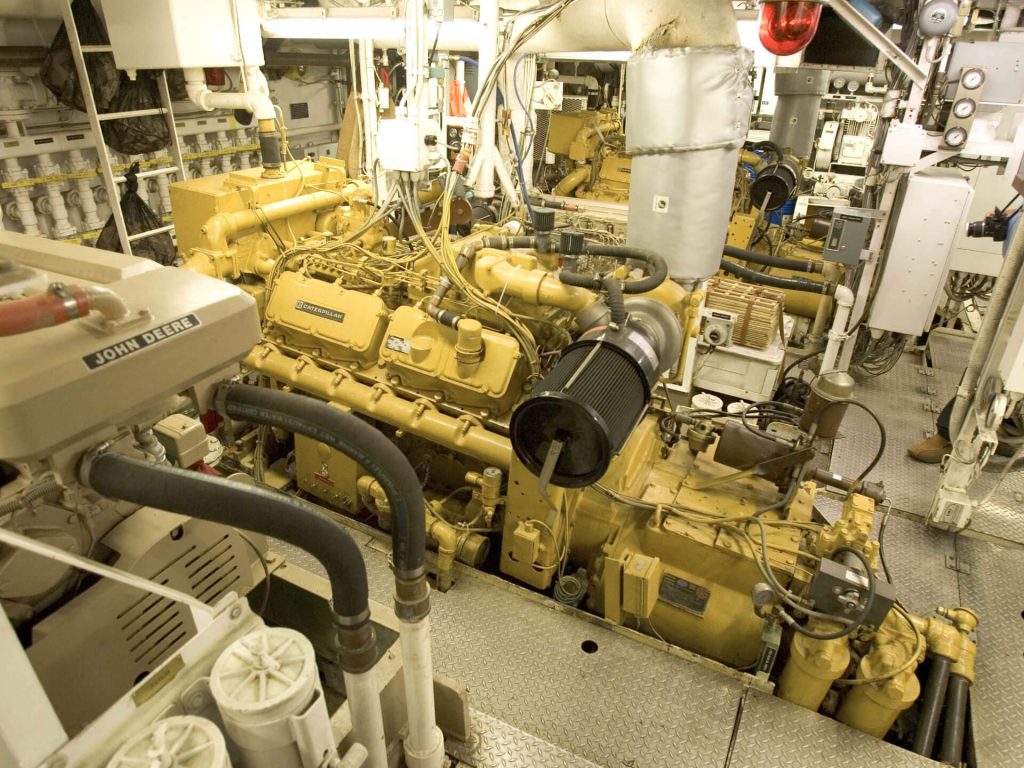
A systematic fault-finding approach for high-speed diesel engines that won't crank, crank but won't fire, or start then stall — covering the checks every engineer should run before calling for outside assistance.
Few things on board concentrate the mind quite like a high-speed diesel engine that refuses to start. Whether it is a generator set, a harbour tug’s main engine, a fast patrol vessel powerplant, or an auxiliary driving a critical pump, a no-start condition at the wrong moment carries real operational and safety consequences. The fault might be trivial — a discharged battery, an open fuel valve — or it might signal something more serious developing inside the engine. Either way, a disciplined, systematic approach will find it faster than guesswork and will avoid making a minor fault worse.
This guide walks through the three most common no-start presentations in sequence: the engine that will not crank at all, the engine that cranks freely but will not fire, and the engine that starts and runs briefly before stalling. Work through the logic in order. Do not skip steps. Document what you find at each stage — this record is valuable both for the immediate repair and for any subsequent class or warranty claim.
Before You Begin: Safety and Pre-Check Discipline
High-speed diesels carry stored energy in multiple forms — electrical, hydraulic, pneumatic and mechanical. Before touching anything, confirm the following baseline conditions are in place.
- Ensure the engine room ventilation is running and there is no smell of fuel, exhaust gas or burning insulation.
- Check that all personnel are clear of rotating components and that the turning gear, if fitted, is disengaged.
- Confirm that any remote start inhibit or maintenance lockout has not been left active by another watch.
- Review the last log entries. Was the engine running normally before the current event? Has any maintenance been carried out recently? A freshly serviced fuel system or a recently replaced sensor is always a prime suspect.
With those basics confirmed, proceed to the first diagnostic branch.
Condition One: Engine Will Not Crank
If the starter engages but the engine does not turn — or if pressing the start button produces nothing at all — the problem lies upstream of the combustion process. Work from the power source outward.
Electrical Starting Systems
Most high-speed diesels in the marine environment use electric starting. Begin at the battery bank. Check the state of charge with a reliable voltmeter under load conditions; a resting voltage that looks acceptable can collapse the moment the starter motor draws current. Check terminal connections for corrosion, looseness or heat damage — a poor connection at a battery terminal generates resistance that can prevent the starter from receiving adequate current. Check the battery isolator switch position. Check any fuses or circuit breakers in the starter circuit; on some installations these are located away from the main panel and are easy to overlook.
If the battery condition and connections are sound, move to the starter motor itself. Listen for the starter solenoid clicking when the start command is given — a click with no rotation suggests the solenoid is energising but the motor is not turning, pointing toward the motor itself or a mechanical engine issue. No click at all suggests the control signal is not reaching the solenoid, directing attention to the start relay, the wiring from the control panel, or a safety interlock that is holding the start circuit open.
Pneumatic Starting Systems
On larger or more demanding high-speed diesel applications, pneumatic starting may be used. Confirm starting air pressure is within the specified range. A pressure that is too low will not overcome engine compression. Check the starting air valve for proper operation and confirm the air line is not blocked or frozen. Check the air distributor timing if the engine has previously run correctly — this is rarely the cause of a sudden no-crank fault but becomes relevant after major overhaul.
Mechanical No-Crank Causes
If the starter motor is receiving power but the engine will not rotate, suspect a mechanical lock. Check whether the engine has hydraulically locked — fuel or cooling water entering a cylinder through a leaking injector or head gasket will prevent rotation and attempting to crank against a hydrostatic lock will cause serious damage. With the start circuit isolated, remove the injectors or decompression valves one by one and attempt to turn the engine by hand. If fluid emerges, identify the source before proceeding. Check the engine oil level — a sudden significant rise may indicate coolant or fuel ingress to the sump.
Also confirm that no auxiliary equipment mechanically coupled to the engine — a gearbox, pump or compressor — has seized and is preventing rotation from that direction.
Condition Two: Engine Cranks but Will Not Fire
The engine turns normally under the starter but combustion does not occur, or only brief, incomplete firing takes place. This condition tells you the mechanical starting system is functioning and the engine is not locked. The fault is in fuel delivery, air supply, compression, or the conditions required for ignition.
Fuel System Checks
This is statistically the most common cause of a cranking no-start and should receive the most thorough attention.
Begin with the fundamentals. Confirm fuel is actually present in the day tank or service tank to an adequate level — sight glasses can become fouled or misleading. Check that all fuel supply valves between tank and engine are fully open. Trace the fuel line from tank to engine looking for any valve inadvertently left closed after maintenance or any section that could have been kinked or damaged.
Check the condition of the primary and secondary fuel filters. A blocked filter will starve the injection system. If the filters are close to service interval or if there is any reason to suspect water or biological contamination in the fuel, change them now. Drain the filter bowls and fuel water separators — water in diesel fuel is one of the most common causes of a difficult-start or no-start condition and is endemic in vessels that have taken fuel from marginal suppliers or stored it for extended periods.
Bleed the fuel system thoroughly. High-speed diesel fuel systems are intolerant of air entrainment. After any filter change, fuel starvation event, or period of disuse, air in the low-pressure fuel circuit will prevent the injection pump from building adequate pressure. Follow the engine manufacturer’s bleeding procedure precisely, working from the lowest point in the circuit toward the injection pump. On many engines this means cracking the bleed screw on the primary filter housing, then the secondary filter housing, then the injection pump itself while cranking or using a hand priming pump until clean, bubble-free fuel flows.
If the low-pressure side is confirmed full of clean fuel, consider the injection pump and injectors. A failed injection pump will produce cranking without firing. Injectors that are blocked or stuck closed will not atomise fuel into the cylinder. Testing these components properly requires specialist equipment, but a useful field test is to carefully crack the high-pressure fuel line at each injector in turn while cranking — fuel should pulse out. Absence of pulsing on all cylinders points toward the pump; absence on individual cylinders toward those specific injectors.
Also confirm that the fuel stop solenoid — the electrical actuator that controls fuel rack position — is energising when the start command is given. This is a very common and easily missed cause of a no-start: the solenoid holds the fuel rack closed unless it receives a supply voltage. Check the solenoid with a multimeter and confirm it is pulling in.
Air Supply Checks
A diesel needs a sufficient charge of clean, compressed air to achieve ignition temperature. Check the air filter element — a severely blocked filter will reduce the air charge enough to prevent starting, particularly in cold conditions or at high altitude. On turbocharged engines, confirm the turbocharger shaft rotates freely by hand and that the intake ducting between the air filter and the turbocharger is intact and unobstructed. A collapsed intake hose is a known cause of hard starting that can be difficult to see without physically squeezing the hose.
Compression
Diesel ignition depends entirely on heat generated by compression. Low compression across one or more cylinders — caused by worn rings, damaged valves, a blown head gasket or bore damage — will prevent starting or result in very hard starting. Compression testing requires the correct adapter for the engine’s injector or decompression valve ports, but it should be considered early in any persistent no-start investigation, particularly on older engines or those that have been opened for repair. Compare readings across all cylinders; a significant spread is as informative as low absolute values.
Cold Starting Aids
In cold ambient conditions, confirm that the cold-start aids are functioning. Glow plugs, intake heaters, or cold-start advance mechanisms may be faulty. If the engine has been standing in cold weather, the lubricating oil viscosity may be so high that the starter cannot achieve adequate cranking speed for compression ignition — pre-heating or use of the correct lower-viscosity oil grade for seasonal conditions may be required.
Condition Three: Engine Starts but Stalls Shortly After
An engine that fires, runs briefly and then stops is often more frustrating than a clean no-start, because it creates a false impression that the problem is nearly solved. In practice, this presentation carries its own set of likely causes.
Fuel Starvation Under Load
The most common cause of start-then-stall is fuel starvation that only manifests once the engine is running and making a draw on the supply. Air trapped in the high-pressure fuel circuit may allow a brief firing event before the fuel column breaks. A fuel lift pump that is weak or failing may supply enough fuel for the initial start but cannot sustain adequate delivery once the engine is running. The fuel return line being blocked or restricted can cause injection pump overflow pressure to rise to the point where fuel delivery is disrupted.
Check and re-bleed the system as described above. Test the lift pump output pressure and volume against the manufacturer’s specification. Inspect the fuel return line for kinks, blockage, or a return valve that is not seating correctly.
Overheating and Safety Shutdowns
If the engine runs for a longer period — several minutes — before stopping, a safety shutdown is the likely cause. High coolant temperature, low lubricating oil pressure, or over-speed protection may be triggering an automatic shutdown. Check the engine control unit or shutdown panel for fault codes or alarm history immediately after the stall — this information is most reliable when read fresh. Investigate the cause of the protection system activation; do not simply reset the alarm and restart without understanding why it tripped.
A coolant system that has not been properly bled after maintenance will show an apparent high-temperature shutdown even if the engine is not actually overheating — an air pocket at the temperature sensor will give a false high reading. Bleed the cooling system thoroughly and check the coolant level.
Fuel Quality and Contamination
Water-contaminated fuel that passed through the filter during the brief running period can cause sudden cutout. Take a fuel sample from the day tank bottom and inspect it. Even a small quantity of water sitting at the bottom of the tank will be drawn up at high flow rates. If contamination is found, the tank must be drained and cleaned before reliable operation will be achieved.
Electrical and Control System Faults
An intermittent fault in the control wiring — a loose connector, a failing sensor, a relay with a poor contact — can allow the engine to start but cause a shutdown once vibration or heat causes the fault to manifest. On electronically controlled engines, retrieve all fault codes from the engine management system. A crank position sensor or camshaft position sensor fault that only triggers when the engine begins to warm up is a known cause of this symptom pattern.
Also check the fuel stop solenoid for intermittent operation — a solenoid that holds in during cranking but drops out once the start circuit hands over to the run circuit due to a wiring fault in the hold-in circuit will produce a clean start followed by immediate stall.
General Guidance for Operators and Masters
Several broader points are worth keeping in mind regardless of which fault branch applies to the situation at hand.
- Always work systematically from simple to complex. The majority of no-start faults have simple causes. Resist the temptation to move straight to injectors or the injection pump before the fuel filters, bleed points and electrical basics have been confirmed.
- If the engine has recently been serviced, suspect the last thing touched. A filter housing not properly re-sealed, a bleed screw not fully tightened, a sensor connector not firmly re-engaged — these are the first things to check after any maintenance-associated no-start.
- Log every finding and every action taken. This is important for the defect record, for any warranty discussion, and for pattern recognition if the fault recurs.
- If a hydrostatic lock is suspected, do not crank the engine again until the investigation is complete. The damage caused by attempting to crank against hydraulic lock can be catastrophic and will not be covered by most insurers or warranties if evidence of the attempt is found during subsequent inspection.
- Know when to stop. If the systematic checks above do not identify a clear cause, the fault may require specialist diagnostic tools — pressure transducer analysis, fuel system flow testing, or engine management diagnostic software. Calling for that assistance before further attempts at starting is not a failure of engineering judgement; it is good practice.
Final Thoughts
A high-speed diesel that refuses to start is almost always telling you something useful — you simply have to ask the right questions in the right order. The fault-finding framework above reflects the same logic that any experienced marine engineer will apply, whether on a fast ferry, an offshore vessel or a critical generating set: work from energy source to combustion, eliminate the simple before investigating the complex, and never assume.
What separates a competent engineer from a reactive one is not the ability to fix faults quickly — it is the discipline to understand them properly before acting. A misdiagnosed no-start that leads to an unnecessary injection pump change, or worse, an attempted start against a hydraulic lock, will cost far more in time, money and credibility than a methodical investigation would have. Build this checklist into your vessel’s planned maintenance documentation. Brief your ratings and junior engineers on the logic behind it, not just the steps. The best time to understand a diesel no-start procedure is before the engine refuses to cooperate.